Why Foldable Mobility Scooters Are Becoming a Global Trend
A 2026 market insight for distributors, importers, and DME retailers
If you follow the senior mobility industry, you’ve noticed a clear shift. More buyers are moving away from bulky traditional scooters. InWhy Foldable Mobility Scooters Are Becoming a Global Trend
A 2026 market insight for distributors, importers, and DME retailers
If you follow the senior mobility industry, you’ve noticed a clear shift. More buyers are moving away from bulky traditional scooters. Instead, they’re choosing foldable, portable models. This isn’t a passing fad. It’s a structural trend driven by maturing technology, evolving user needs, and China’s supply chain advantage.
In this article, we break down the growth logic of foldable mobility scooters. We’ll look at market data, user demand, and technical innovation. By the end, you’ll know whether to stock this category.
1. Market Data: Foldable Models Are Taking the Largest Share
Compact Scooters Now Dominate Revenue
According to industry research, compact scooters under 110 cm accounted for 45.55% of global mobility scooter revenue in 2025. As a result, they are now the dominant category by far. The reason is simple. Most daily travel happens in apartment hallways, supermarket aisles, hospital corridors, and homes. These spaces have hard limits on turning radius and width. Therefore, traditional large scooters simply can’t operate in them.
Growth Rates Tell the Same Story
The growth rate is even more telling. The foldable wheeled personal mobility robot market reached a 16.2% CAGR in 2025. It’s projected to grow from USD 1.43 billion to USD 3 billion by 2029. Meanwhile, the large scooter segment is expanding at a 9.25% CAGR. Carbon fiber frame technology now reduces chassis weight by over 30%. As a result, “large models that still fit in a trunk” are now a reality.
Personal Use Is Driving the Boom
One core driving force is the explosion of personal-use scenarios. Personal use accounts for 88.12% of the mobility scooter market, far exceeding institutional procurement. When the device shifts from “a fixed asset in a hospital” to “a personal travel companion,” everything changes. Consequently, foldability, portability, and storability go from nice-to-have features to hard requirements.
2. Three Demand-Side Drivers
2.1 From “Medical Device” to “Lifestyle Product”
Traditional mobility scooters have long been categorized as medical equipment. They’re bulky, limited in color options, and psychologically associated with illness. However, this is changing fast.
Take Dongguan-based Qunwang Technology as an example. Its carbon fiber, one-touch remote-control folding scooters are now exported to dozens of countries. The company observed a profound shift in senior demand. “The most visible change is the de-medicalization of aesthetics,” a company representative said. “Seniors today no longer want bulky-looking equipment. Instead, they prefer minimalist, stylish designs with soft color palettes.”
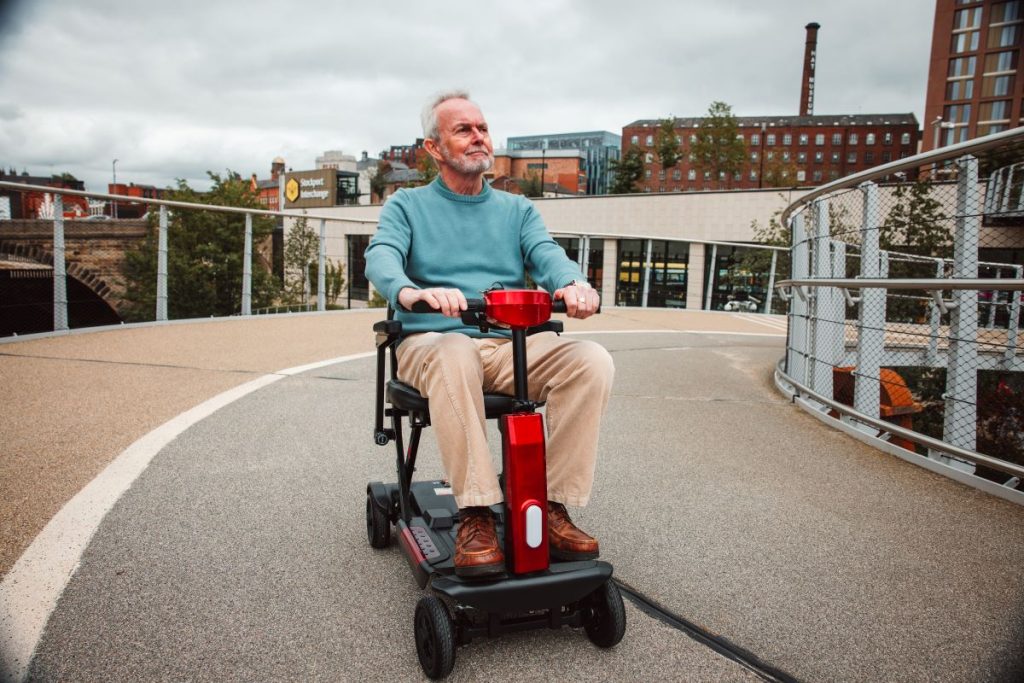
This cognitive shift is expanding the user base. Scooters are no longer just a “necessity” for those with limited mobility. Instead, they’re becoming an outdoor travel, family-visit, and leisure companion for active seniors. When usage extends from indoor to outdoor, portability becomes a rigid requirement.
2.2 Real Constraints of Living Space and Travel Patterns
Limited living space in urban households is a practical reason foldability has become a “hard necessity.” A scooter that can’t fold requires dedicated parking space. In contrast, a model that folds to stand in an entryway, fit in a closet, or slide into a trunk is far more practical. For most families, it’s the only acceptable option.
Meanwhile, the rise of the “4+2” travel model confirms the same logic. This means four-wheel car plus two-wheel folding bike. The folding bicycle market exceeded RMB 15 billion in offline retail sales in 2025. Moreover, mainstream e-commerce platform sales grew 100% year-over-year in 2026. Consumers want a seamless experience: drive to the suburbs, unfold the bike, and ride. Mobility scooter users want exactly the same thing. The device must follow the person, not the other way around.
2.3 Policy and Infrastructure Support
Globally, governments are improving mobility access for seniors and people with disabilities. They’re doing this through standards, subsidies, and tax incentives. As a result, adoption of electric mobility devices is rising. In the U.S., Medicare Part B provides 80% reimbursement coverage. Combined with over 8,000 durable medical equipment retail outlets, this offers financial feasibility for individual buyers.
Infrastructure improvements matter too. Better wheelchair accessibility on sidewalks, in parks, and at public facilities increases the practicality of outdoor scooters. When the urban environment is more scooter-friendly, users naturally gravitate toward foldable models. After all, they want a device they can take out and put in the car.
3. Technical Breakthroughs: Folding Is No Longer a Compromise
The core skepticism early foldable scooters faced was simple. Does folding mean sacrificing stability and range? Fortunately, the maturity of carbon fiber and lightweight materials is eliminating that concern.
Lighter Materials, Smoother Rides
Material breakthroughs are the most significant. Carbon fiber frame applications reduce chassis weight by over 30%. In addition, they reduce vibration by 18%, which improves ride comfort on rough surfaces. Pride Mobility’s Go-Go Carbon weighs just 35 lbs. Similarly, Rascal’s Carbon Cruiser is 46 lbs. These numbers mean one person can easily lift the device into a trunk or onto a plane.
Folding Mechanisms Are Evolving Fast
The folding mechanism itself is also evolving. One-touch remote-control folding lets the vehicle collapse into a towable “suitcase” form in seconds. Moreover, this technology is backed by more than 250 domestic and international patents. From manual folding to automatic folding, the barrier to folding is disappearing. As a result, users no longer need to bend down to operate anything.
Smart Features Are the Next Differentiator
Smart features are the next wave of differentiation. Industry trends show GPS tracking, app integration, and real-time diagnostics becoming standard. Predictive maintenance is also emerging on premium folding models. These features improve user experience and create potential for software subscription revenue. Furthermore, some Chinese manufacturers are already developing IoT and smart navigation capabilities. For example, if the vehicle detects abnormal vibration or emergency braking, the system automatically alerts family members’ phones.
4. Supply Chain Advantage: China’s Rapid Iteration Capability
Behind the acceleration of the foldable scooter trend is an often-overlooked factor. That factor is the responsiveness of China’s supply chain.
Component Density in Dongguan
Houjie, Dongguan, sits at the heart of the global mobility scooter supply chain. Components here span dozens of categories. These include aluminum alloy parts, lithium batteries, and precision hardware. Moreover, the vast majority of upstream and downstream manufacturers are concentrated in Dongguan and surrounding areas. As a result, prototype development and sampling response speed far exceeds other regions.
From Drawing to Mass Production in Weeks
This supply chain density dramatically compresses the production cycle. When a new demand emerges, manufacturers respond fast. For instance, suppose a buyer says, “we need a lighter carbon fiber folding model.” In that case, manufacturers can complete sampling, testing, and adjustments within weeks, not months. Consequently, Chinese foldable scooter brands can rapidly capture overseas markets.
5. Boundaries and Challenges of the Trend
The rise of foldable scooters doesn’t mean they suit everyone. In fact, the industry still faces several real constraints.
Cost Remains a Barrier
Batteries account for roughly 30% of scooter price. High-performance lithium batteries and carbon fiber materials add further cost. As a result, premium folding models are significantly more expensive than traditional entry-level options. In price-sensitive markets, cost remains the primary obstacle to adoption.
Physical Limits of Stability
Four-wheel scooters hold 57.53% of the market. This shows that user demand for stability and traction in outdoor scenarios is real. However, folding designs must reduce weight without sacrificing that stability. Therefore, this remains an ongoing engineering challenge.
Inertia in Social Perception
For people with disabilities below retirement age, using a scooter still carries some social stigma. Therefore, this limits penetration of foldable scooters into broader age groups. Nevertheless, as the “lifestyle” positioning spreads, this barrier is gradually softening.
6. How to Choose the Right Foldable Mobility Scooter
With so many models on the market, buyers often ask which specs matter most. Here’s a quick breakdown to guide your sourcing decision.
Weight and Portability
Weight is the first spec to check. For travel use, aim for a model under 40 lbs. Carbon fiber frames are lighter, but they cost more. In contrast, aluminum frames are cheaper but slightly heavier. Therefore, decide based on your target customer’s needs.
Battery Range and Charging
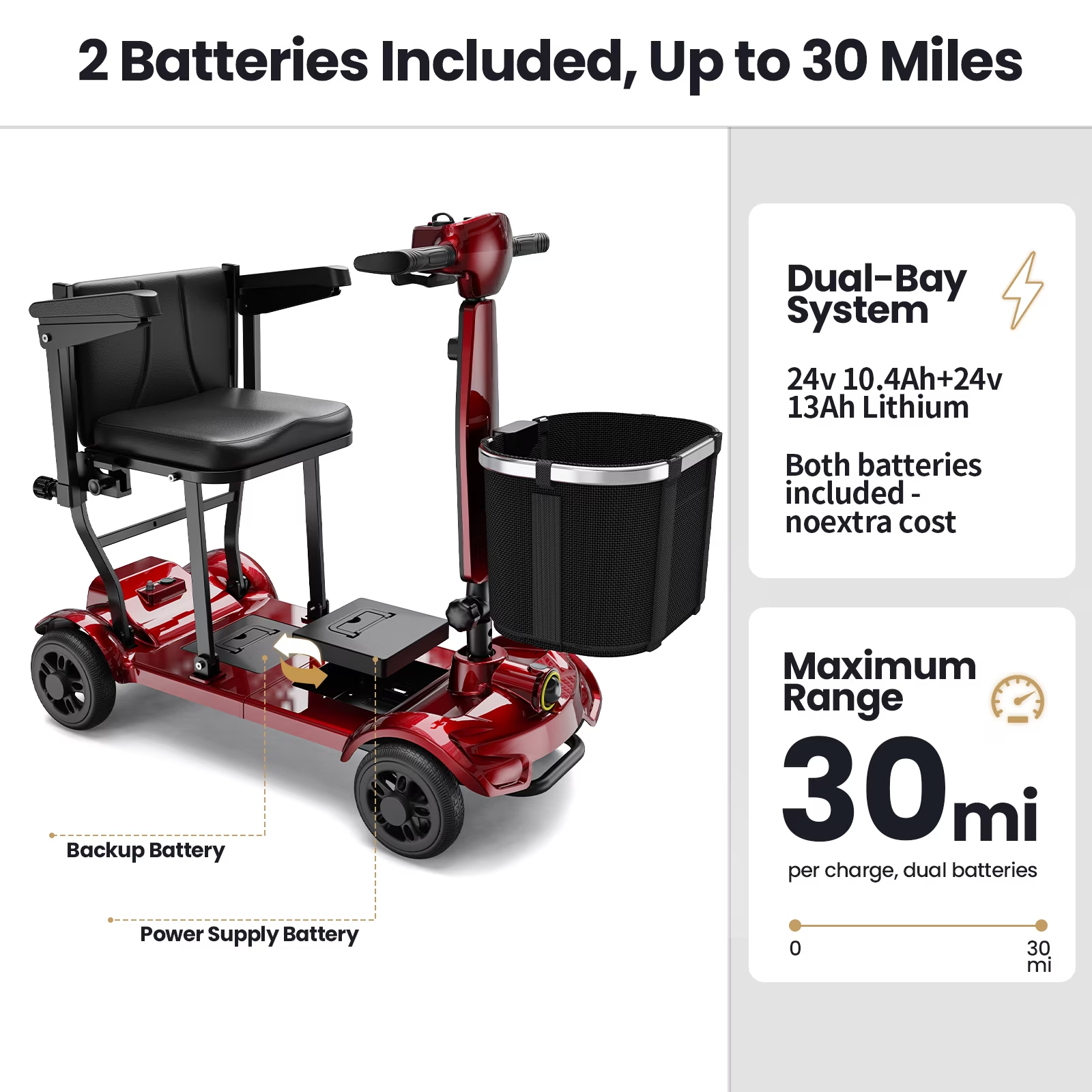
Most lithium batteries provide 15–25 km (9–15 miles) per charge. For daily errands, this is enough. However, for full-day outdoor trips, look for extended-range options. Also check whether the battery is airline-compliant if your market includes frequent travelers.
Folding Mechanism
Manual folding is cheaper. However, auto folding is far more convenient for seniors with limited strength. Moreover, one-touch remote-control folding is becoming the new standard. Consequently, it’s a strong selling point for premium models.
Stability and Wheel Configuration
Four-wheel scooters offer better outdoor stability. Three-wheel models turn tighter indoors. Since most users ride outdoors, 4-wheel folding models are usually the safer bet. Additionally, check the max load capacity and suspension quality.
Certification and Market Compliance
Always verify certifications before importing. CE is required for the EU. FDA registration matters for the U.S. ISO standards support broader market access. In addition, confirm whether the model qualifies for Medicare Part B reimbursement if you sell into the American DME channel.
Conclusion
Foldable mobility scooters are becoming a trend because they solve a real problem. People with limited mobility don’t want to be “tied down” by their device. They need a mobility tool that follows the car, fits in the trunk, and stores in a closet. They don’t want a “medical device” that requires rearranging their living space.
The data already proves the scale of this demand. We’re seeing a 16.2% annual growth rate and a 45.55% compact-segment market share. Meanwhile, carbon fiber materials and automatic folding mechanisms are turning foldable designs from a “compromise” into a “preferred solution.” On the supply side, China’s rapid supply chain iteration provides a solid foundation.
For distributors, importers, and DME retailers, foldable scooters are not a passing fad. Instead, they represent a structural shift from “medicalized” to “lifestyle-oriented” mobility. And this shift has only just begun.
Frequently Asked Questions
Product Basics
Q: What is the best foldable mobility scooter for travel?
A: Look for a lightweight folding mobility scooter under 40 lbs. Choose one with a lithium battery and a compact folded footprint. Carbon fiber travel mobility scooters are ideal because they’re light enough for one person to lift.
Q: How much does a foldable mobility scooter weigh?
A: Premium carbon fiber models range from 35 lbs (16 kg) to 46 lbs (21 kg). In contrast, traditional steel-frame scooters typically weigh 60–100 lbs. That’s why lightweight folding models are growing so fast.
Q: What’s the difference between a folding mobility scooter and a travel mobility scooter?
A: They overlap heavily. A travel mobility scooter is designed for portability. It’s lightweight, foldable, and airline-friendly. A folding mobility scooter emphasizes the folding mechanism. Most premium models today are both.
Sizing and Compatibility
Q: Can a folding mobility scooter fit in a car trunk?
A: Yes. Most auto folding mobility scooters collapse into a suitcase-like form that fits standard car trunks. However, measure your trunk dimensions and compare with the folded size before ordering.
Q: Is a 4-wheel or 3-wheel folding scooter better?
A: Four-wheel scooters hold 57.53% of the market because they offer better stability and traction outdoors. In contrast, three-wheel models turn tighter indoors. For most buyers, 4-wheel folding models are the safer choice.
Q: How long does the battery last on a folding mobility scooter?
A: Most lithium batteries provide 15–25 km (9–15 miles) of range per charge. They also last 2–3 years with regular use. Batteries account for roughly 30% of the total unit cost.
Pricing and Coverage
Q: What is the price range for a foldable mobility scooter?
A: Entry-level folding models start around USD 300–600. Premium carbon fiber auto-folding models range from USD 800–2,500. Pricing depends on battery, motor, and smart features. Wholesale pricing depends on order volume.
Q: Are foldable mobility scooters covered by Medicare?
A: In the U.S., Medicare Part B may cover mobility scooters at 80% reimbursement. However, coverage requires medical necessity and a doctor’s prescription. Check current DME requirements for your market.
Sourcing and OEM
Q: Do you offer OEM/ODM for foldable mobility scooters?
A: Yes. As a China-based portable mobility scooter manufacturer, we support custom branding, color, packaging, and specifications. Contact us for MOQ and lead time details.
Q: How do I choose a foldable mobility scooter supplier in China?
A: Look for a factory-based supplier in Dongguan or the surrounding region. Verify patents and certifications such as CE, FDA, and ISO. Then request a sample order and confirm OEM/ODM capability before committing to bulk.Ready to Stock the Trend?
Foldable mobility scooters are the fastest-growing segment in the personal mobility market. The CAGR sits at 16.2% and keeps climbing. Don’t let your competitors get there first.
📩 [Contact Us for a Quote]
Email : [email protected]
Tel : +86-199 9682 3777