Walker vs Rollator: What’s the Difference?
When a cane no longer provides enough support for safe walking, the next step is usually a walker or a rollator. For distributors, home care agencies, and retail buyers, the walker vs rollator comparison is not just a clinical question—it directly affects purchasing decisions, inventory mix, and end-user satisfaction.
The confusion is understandable. Both products fall under the “walking aid” umbrella. Both feature a frame and handles. But the presence of wheels and a seat changes everything about how the device is used, who it suits, and where it performs best.
This guide breaks down the walker vs rollator decision from a product and sourcing perspective, with the key specifications your customers will ask about.
Walker vs Rollator: The Core Difference Is the Wheels
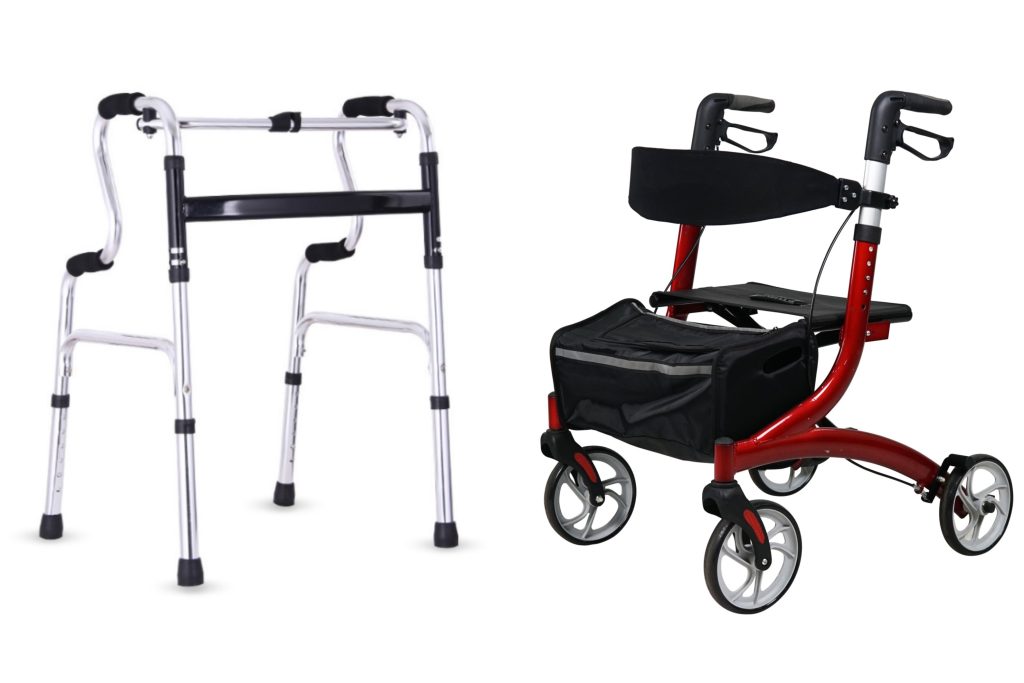
A standard walker (also called a walking frame) is a four-legged metal frame with rubber tips and no wheels—or, in some models, two front wheels. The user must lift the frame, place it forward, and then step to it. This “lift-and-place” motion is slower and more physically demanding, but it provides the highest level of stability because the device does not roll away when weight is applied.
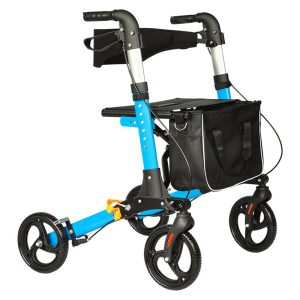
A rollator (rolling walker) has three or four wheels, hand-operated brakes, and typically a built-in seat. The user pushes it forward in a continuous motion rather than lifting it. This design preserves a more natural gait and allows for longer distances, but it requires adequate hand strength and coordination to operate the brakes safely.
For B2B buyers, the walker vs rollator distinction should guide category planning: walkers serve the stability-first segment, while rollators serve the mobility-and-endurance segment. A well-rounded product portfolio often carries both.
https://www.yourcompany.com/images/standard-walker-indoor.jpg
https://www.yourcompany.com/images/rollator-outdoor-mobility.jpg
When a Walker Is the Right Product
Walkers are indicated for users who need substantial weight-bearing support or have significant balance impairment. Clinical guidance consistently positions the standard walker as the most stable option because its non-rolling design means it will not translate unless deliberately moved.
Typical user profiles:
- Post-surgical patients with weight-bearing restrictions (hip or knee replacement, fracture recovery)
- Individuals with bilateral lower-limb weakness or generalized deconditioning
- Users with poor balance who cannot safely manage a rolling device
- Indoor use on flat, smooth surfaces where maneuverability matters more than speed
Key product specifications to verify:
- Weight capacity. Standard walkers typically support a meaningful percentage of body weight; confirm load ratings for your target market.
- Height adjustment range. Handle height should allow a slight elbow bend (approximately 30 degrees) when standing upright.
- Tip quality. Rubber tips are the only ground-contact point; look for reinforced tips with steel inserts for durability.
- Folding mechanism. Push-button or lever-release designs vary in ease of use; test locking security.
A two-wheel walker (front wheels, rear glides) is a useful intermediate SKU. It reduces the energy cost of lifting while retaining most of the stability of a fixed-frame model.
Featured products:
- Standard Folding Walker with Rubber Tips — steel frame, adjustable height, reinforced non-slip tips
- Two-Wheel Walker with Front Casters — reduced lifting effort, rear glide tips, folding design
When a Rollator Is the Better Fit
Rollators are engineered for users who can walk but need balance support, endurance assistance, or a place to rest. The seat is not an amenity—it is a clinical feature that enables community participation for users with cardiopulmonary limitations, chronic fatigue, or general deconditioning.
https://www.yourcompany.com/images/four-wheel-rollator-seat.jpg
Typical user profiles:
- Older adults who tire easily and need frequent rest breaks
- Users with mild to moderate balance challenges but intact brake-control ability
- Individuals who want to remain active outdoors, shop, or attend appointments independently
- Post-rehabilitation users transitioning from a walker toward greater independence
Key product specifications to verify:
- Brake system. Hand brakes must be reachable and easy to squeeze; push-down locking brakes are common on four-wheel models. This is the single most important safety feature.
- Seat height and width. The user should be able to sit with feet flat on the ground and stand up safely using the handles.
- Wheel size. Larger wheels (6–8 inches) handle outdoor surfaces—sidewalks, gravel, thresholds—more effectively than small casters.
- Frame material and weight. Aluminum is the standard for retail and home care; carbon fiber serves the premium and travel segments at higher price points.
- Accessories. Baskets, bags, cane holders, and oxygen tank holders are common add-on revenue opportunities.
A critical contraindication to note in product descriptions and sales training: a rollator is not a weight-bearing device. Users who lean heavily on the frame as they would a walker risk displacing the rollator forward, a documented fall mechanism. Clear labeling and customer education matter here.
Featured products:
- Four-Wheel Rollator with Seat and Hand Brakes — aluminum frame, 8-inch wheels, padded seat, storage basket
- Lightweight Travel Rollator — foldable aluminum frame, compact for transport, locking brakes
Walker vs Rollator: Side-by-Side Comparison for Buyers
| Feature | Walker | Rollator |
|---|---|---|
| Wheels | None, or 2 front wheels | 3 or 4 wheels |
| Brakes | None | Hand-operated, lockable |
| Seat | No (some models offer stand-assist) | Yes, most four-wheel models |
| Primary stability mechanism | Fixed frame, non-rolling | Brake control + user coordination |
| Best use environment | Indoor, flat surfaces | Indoor and outdoor |
| Weight-bearing support | High | Low (not designed for weight-bearing) |
| Typical user | Post-surgical, significant balance impairment | Active but fatigued, needs rest breaks |
| Key selling point | Maximum safety | Independence and endurance |
Sourcing Considerations for Distributors and Retailers
For B2B buyers building a mobility aid category, three practical factors deserve attention.
Certification and compliance. Rollators and walkers are regulated as medical devices in most major markets. For the EU, CE marking under MDR is required, with EN 12182 as the relevant standard for assistive products. For the US, FDA Class I registration and listing apply (510(k) exempt for most walkers and rollators), along with Quality System Regulation compliance. ISO 13485 certification is not universally mandated but is effectively expected by major distributors and procurement agencies.
Market positioning by material. Steel frames occupy the institutional and budget segment ($40–$56 FOB range). Aluminum dominates retail and home care ($47–$67 FOB). Carbon fiber serves the premium, travel, and sports rehabilitation markets ($150–$228 FOB). A mixed-material portfolio captures multiple buyer segments without overextending on a single price tier.
Accessory and replacement-part revenue. Tips, glides, wheels, baskets, and brake cables are consumable items that generate repeat orders. Distributors who bundle accessories with primary devices often see stronger account retention than those selling frames alone.
Walker vs Rollator: A Decision Framework for Your Customers
When advising end users or training retail staff, two questions cut through most of the confusion:
“Do you need to put significant weight on the device, or do you need help with balance and fatigue?”
If weight-bearing is the priority—especially after surgery or with significant balance loss—a walker is the safer recommendation.
“Do you want to go outdoors, walk longer distances, and sit down when needed?”
If the user can walk but tires easily or wants to maintain community mobility, a rollator with a seat and reliable brakes is the appropriate choice.
If both needs exist over time, the progression from walker to rollator is a normal rehabilitation pathway. Some users keep both: a standard walker for bathroom trips at night and a rollator for daytime outings.
Frequently Asked Questions
Q: Can a rollator be used as a walker?
A: No. Rollators are not designed for weight-bearing support. Leaning heavily on a rollator displaces it forward and increases fall risk. Users who need to offload body weight should use a standard or two-wheel walker.
Q: What is the minimum order quantity for walkers and rollators from Chinese manufacturers?
A: MOQs vary by material and supplier. Aluminum and steel models commonly start at 100 pieces; carbon fiber and premium configurations may be available at 10–20 pieces from certain manufacturers.
Q: Are walkers or rollators covered by insurance or Medicare?
A: In the US, both categories are generally eligible for reimbursement under Medicare Part B when prescribed as medically necessary durable medical equipment. Exact coverage varies by plan and region. Distributors should verify coding and documentation requirements with their billing partners.
Q: What certifications should I require from a supplier?
A: At minimum: CE marking for EU-bound products, FDA establishment registration and device listing for US-bound products, and ISO 13485 quality management certification. Request test reports for EN 12182 compliance and load-capacity verification.
Q: Which product is better for outdoor use?
A: Rollators, without question. Larger wheels, brakes, and a seat make outdoor navigation practical. Standard walkers are best reserved for indoor, flat surfaces.
Conclusion: Making the Walker vs Rollator Choice
Walkers and rollators are not interchangeable SKUs. They serve distinct user needs defined by weight-bearing requirements, balance capability, and lifestyle goals. For distributors and retailers, carrying both categories—with clear product descriptions and staff training on the wheels-and-seat distinction—creates a more complete mobility solution and reduces the risk of mis-purchasing that leads to returns or, worse, avoidable falls.
If you are evaluating suppliers or expanding your mobility aid line, contact our team for current specifications, certification documentation, and wholesale pricing on walkers and rollators. You can also browse our full Mobility Aids Catalog to compare models side by side.